There is no such power, no such dominance
Over the course of all lifetimes
No better source of education at all age
No better book or educator
No better food
No better church and art form
Than the rising power of an early sun,
The eternal youth displayed
Morning
I shall eternally sing your praise
Our life in reverse is your history
Your are the true one
No better time exists in the world
Than yours
And every day you give us your magic
Unattainable
Your spirits, generously poured
No limits, you say, no limits, far beyond our understanding.


17_07_24
admiration/amour
Idée qui vient de l'association primordiale peu souvent évoquée de l'amour et de l'admiration:
Ce qui fonde l'admiration-amour pour une personne: un équilibre (toujours précaire, c-à-d que ce n'est pas seulement un rapport de forces équilibré, où les forces s'annulent sans besoins ni risques extérieurs ou intérieurs, mais bien un point fragile de l'espace-temps où de multiples forces changeantes se rencontrent et trouvent temporairement une entente, une trêve à chaque instant propice à sa remise en question) entre les éléments de ce qui fait la personne, les pulsions dans le bain du moi/surmoi/ça, les énergies plus ou moins ou plutôt inconnues de la personnalité à jamais mystérieuse car fondées sur un puit-flamme insondable que l'on reconnaît à chaque action de la personne et qui nous fascinent: des actions qui nous font miroiter, qui nous transcendent, nous hypnotisent.
D'où la question: comme le mouvement de la mer et des vagues nous hypnotisent par leur permanente complexité, par l'infini changement continu de chaque morceau de la mer, peut-on aussi être hypnotisé par un seul point-rencontre où ce sont les énergies, invisibles mais imaginées, de la personne, qui seraient cet infinitude quais-invisible, "quasi" car on a bien l'impression de voir, en tout cas de ressentir, ces énergies, cette infinité, dans les actions de l'être aimé. Sorte d'auto-hypnose: on regarde l'être et on essaye de voir au travers de ce qui se montre, on se prend à imaginer comme une mer ces mouvements équilibrés qui fondent la personnalité, et notre amour est en fait le résultat d'un miroitement fascinant d'une mer imaginée qui nous fixe et nous captive, une captivation créée par soi vers un insondable intérieur de l'autre, qu'on ne reconnaît même pas! Alors que la mer nous fascine objectivement et sans méprise sur ce qui nous fascine, l'amour cache l'objet de cette fascination, pourtant ô si forte! Tour de passe-passe phénoménal, absolument sans comparaison possible, on est transfixé par ce je ne-sais-quoi omnipotent sur nous, puissant, trop puissant, force invisible qui crée à son tour un nouveau mystère, proprement magique, fantastique, miroir ouvert du non-réel dans le monde.
Ce qui fonde l'admiration-amour pour une personne: un équilibre (toujours précaire, c-à-d que ce n'est pas seulement un rapport de forces équilibré, où les forces s'annulent sans besoins ni risques extérieurs ou intérieurs, mais bien un point fragile de l'espace-temps où de multiples forces changeantes se rencontrent et trouvent temporairement une entente, une trêve à chaque instant propice à sa remise en question) entre les éléments de ce qui fait la personne, les pulsions dans le bain du moi/surmoi/ça, les énergies plus ou moins ou plutôt inconnues de la personnalité à jamais mystérieuse car fondées sur un puit-flamme insondable que l'on reconnaît à chaque action de la personne et qui nous fascinent: des actions qui nous font miroiter, qui nous transcendent, nous hypnotisent.
D'où la question: comme le mouvement de la mer et des vagues nous hypnotisent par leur permanente complexité, par l'infini changement continu de chaque morceau de la mer, peut-on aussi être hypnotisé par un seul point-rencontre où ce sont les énergies, invisibles mais imaginées, de la personne, qui seraient cet infinitude quais-invisible, "quasi" car on a bien l'impression de voir, en tout cas de ressentir, ces énergies, cette infinité, dans les actions de l'être aimé. Sorte d'auto-hypnose: on regarde l'être et on essaye de voir au travers de ce qui se montre, on se prend à imaginer comme une mer ces mouvements équilibrés qui fondent la personnalité, et notre amour est en fait le résultat d'un miroitement fascinant d'une mer imaginée qui nous fixe et nous captive, une captivation créée par soi vers un insondable intérieur de l'autre, qu'on ne reconnaît même pas! Alors que la mer nous fascine objectivement et sans méprise sur ce qui nous fascine, l'amour cache l'objet de cette fascination, pourtant ô si forte! Tour de passe-passe phénoménal, absolument sans comparaison possible, on est transfixé par ce je ne-sais-quoi omnipotent sur nous, puissant, trop puissant, force invisible qui crée à son tour un nouveau mystère, proprement magique, fantastique, miroir ouvert du non-réel dans le monde.
17_03_18
on normativity and subjectivity // sur le normatif et le subjectif
Canguilhem:
« Normative is what institues norms. »
« Normativity is invention, what allows an organism to attack its environment or to resist it. [...] Vitality escapes facticity, positivity. »
A norm is: a more or less precise measure from a fact of life that is the average out of a population (point of view from a fact, from the past), or, a socially established ideal from that fact of life (point of view from an idea, from the future).
The fact of life that the norm is based upon is related to an attribute: moral, aesthetic, subjective desirability.
Normativity is philosophically opposed to positivity (i.e. descriptions, explanations) when describing types of theories, beliefs, or propositions.
I believe that:
Attributes (good, beautiful, just) and judgement claims are based on objectivity, but that objectivity in those case especially suffer from two issues: complexity, and lack of accessibility.
E.g. complexity: an act is righteous in respect to a rule of law or moral, and this rule can be defined objectively however would require a lengthy amount of work.
E.g. accessibility: something is beautiful by its mathematical closeness to the particular combination of psychological processes (such as comparison, projection, etc.) and ingrained cultural references, however is too obscure for our era to know how to define them.
Thus subjectivity is always a condensed expression based on a hidden objectivity.
What defines human intelligence is that its way of apprehending information is through the computation of averaging, dissecting and pattern-matching (whereas digital intelligence for instance handles information by direct one-to-one representation) thus allowing highly condensed forms to be appropriated over time, albeit always without even partial equality (capacity to reproduce exactly).
//
Canguilhem (approximativement):
«Le normatif est ce qui institue des normes. »
«La normativité est invention, ce qui permet à un organisme d'attaquer son environnement ou de lui résister. [...] La vitalité échappe à la facticité, à la positivité. »
Une norme est: une mesure plus ou moins précise d'un fait de vie qui est la moyenne d'une population (point de vue d'un fait, du passé), ou un idéal socialement établi à partir de ce fait de vie (point de vue d'une idée, de l'avenir).
Le fait de vie dont est basée la norme est lié à un attribut: moral, esthétique, de désirabilité subjective.
La normativité est philosophiquement opposée à la positivité (c'est-à-dire descriptions et explications) lorsqu'elle décrit des types de théories, de croyances ou de propositions.
Je crois que:
Les attributs (bon, beau, bien) et jugements subjectifs sont fondés sur l'objectivité, mais l'objectivité dans ces cas souffre particulièrement de deux problèmes: la complexité et le manque d'accessibilité.
Par exemple. Complexité: un acte est juste à l'égard d'une règle de droit ou de morale, et cette règle peut être définie objectivement, mais nécessiterait une longue quantité de travail.
Par exemple. Accessibilité: quelque chose est beau par sa proximité mathématique envers la combinaison particulière des processus psychologiques (comparaison, projection, etc.) et les références culturelles enracinées, mais est trop obscur pour notre ère de savoir les définir.
Ainsi, la subjectivité est toujours une expression condensée basée sur une objectivité cachée.
Ce qui définit l'intelligence humaine, c'est que sa façon d'appréhender l'information consiste en calculs de moyenne, de dissection et d'appariement des formes (alors que l'intelligence numérique par exemple gère l'information par représentation directe un-à-un) permettant ainsi l'appropriation de formes très condensées au fil du temps, mais toujours sans égalité même partielle (capacité à reproduire exactement).
« Normative is what institues norms. »
« Normativity is invention, what allows an organism to attack its environment or to resist it. [...] Vitality escapes facticity, positivity. »
A norm is: a more or less precise measure from a fact of life that is the average out of a population (point of view from a fact, from the past), or, a socially established ideal from that fact of life (point of view from an idea, from the future).
The fact of life that the norm is based upon is related to an attribute: moral, aesthetic, subjective desirability.
Normativity is philosophically opposed to positivity (i.e. descriptions, explanations) when describing types of theories, beliefs, or propositions.
I believe that:
Attributes (good, beautiful, just) and judgement claims are based on objectivity, but that objectivity in those case especially suffer from two issues: complexity, and lack of accessibility.
E.g. complexity: an act is righteous in respect to a rule of law or moral, and this rule can be defined objectively however would require a lengthy amount of work.
E.g. accessibility: something is beautiful by its mathematical closeness to the particular combination of psychological processes (such as comparison, projection, etc.) and ingrained cultural references, however is too obscure for our era to know how to define them.
Thus subjectivity is always a condensed expression based on a hidden objectivity.
What defines human intelligence is that its way of apprehending information is through the computation of averaging, dissecting and pattern-matching (whereas digital intelligence for instance handles information by direct one-to-one representation) thus allowing highly condensed forms to be appropriated over time, albeit always without even partial equality (capacity to reproduce exactly).
//
Canguilhem (approximativement):
«Le normatif est ce qui institue des normes. »
«La normativité est invention, ce qui permet à un organisme d'attaquer son environnement ou de lui résister. [...] La vitalité échappe à la facticité, à la positivité. »
Une norme est: une mesure plus ou moins précise d'un fait de vie qui est la moyenne d'une population (point de vue d'un fait, du passé), ou un idéal socialement établi à partir de ce fait de vie (point de vue d'une idée, de l'avenir).
Le fait de vie dont est basée la norme est lié à un attribut: moral, esthétique, de désirabilité subjective.
La normativité est philosophiquement opposée à la positivité (c'est-à-dire descriptions et explications) lorsqu'elle décrit des types de théories, de croyances ou de propositions.
Je crois que:
Les attributs (bon, beau, bien) et jugements subjectifs sont fondés sur l'objectivité, mais l'objectivité dans ces cas souffre particulièrement de deux problèmes: la complexité et le manque d'accessibilité.
Par exemple. Complexité: un acte est juste à l'égard d'une règle de droit ou de morale, et cette règle peut être définie objectivement, mais nécessiterait une longue quantité de travail.
Par exemple. Accessibilité: quelque chose est beau par sa proximité mathématique envers la combinaison particulière des processus psychologiques (comparaison, projection, etc.) et les références culturelles enracinées, mais est trop obscur pour notre ère de savoir les définir.
Ainsi, la subjectivité est toujours une expression condensée basée sur une objectivité cachée.
Ce qui définit l'intelligence humaine, c'est que sa façon d'appréhender l'information consiste en calculs de moyenne, de dissection et d'appariement des formes (alors que l'intelligence numérique par exemple gère l'information par représentation directe un-à-un) permettant ainsi l'appropriation de formes très condensées au fil du temps, mais toujours sans égalité même partielle (capacité à reproduire exactement).
16_09_21
If you have too much (needs rework)
1. If you have too much, you have no thing to lose
2. i.e there is nothing you can lose (since you have too much)
3. you can no longer really reject anything in your possession
4. things become attached to you
5. you become a thing-being, an object-subject
6. you lose the capacity of removal
7. and gaining has lost its sense
8. there is no longer a goal in winning
9. or a need for this goal
10. and minor, fun risks have become actually dangerous: you can either die, which is losing too much, or not lose at all.
11. Dying means losing too much in the same way as losing too much means dying.
12. Having too much is like being on a cliff: losing means falling, hence having too much also means losing too much automatically, and implies dying. A poor person cherishes their possessions but does not die from losing them. There is a unit of measure for possessiveness which acts like mass acts with gravity.
13. Like gravity, having too much transforms you into a black hole, possession being attracted to possession, like mass and gravity.
14. The possession unit contains a psychological dynamic of joy:
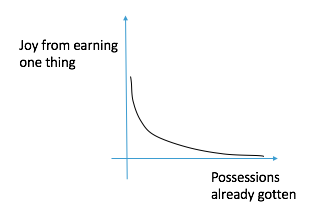
15. If you have too much, you forget the struggles and the sense of life.
16. By losing incentive, you lose desire.
17. By losing desire, you lose identity.
18. You lose the capacity to really lose but gain all meaningful losses: the Big Loss(es).
19. Paradoxically, by gaining too much, you also reach something really meaningful.
Perhaps it's the concept of possession that should be replaced with something else, for instance being immortal:
- if you are immortal, you have no thing to lose...etc
down to:
- Dying means being immortal in the same was as being immortal means dying.
And the unit of measure would be our capacity to survive.
This works quite well.
What about: living fully every second of the day:
- if you live fully every second of the day, you have no thing to lose...etc
This works well in a way, a more positive way than the dying one.
What else?
Perhaps it's a play on the words "too much". What does "too much" mean in the concept of ownership? "Too much" means breaking the rules. If I break the rules of ownership, it means I cannot own anymore, I no longer own, I don't have the capacity OR THE RIGHT to own.
What else?
Perhaps it's a play on the words "too much". What does "too much" mean in the concept of ownership? "Too much" means breaking the rules. If I break the rules of ownership, it means I cannot own anymore, I no longer own, I don't have the capacity OR THE RIGHT to own.
What else?
16_09_09
Freedom Fallacies
Right at this moment, I have a sudden feeling of freedom.
Freedom implies the absence of limitations, a loss of barriers. So if it's a loss, it should be painful.
The sudden disappearance of sweet protective coating that made us not have to think about possibilities that were impossible, this should be painful, as some of those limitations were our own creations. Like a dam breaking, a simultaneous invasion of a dangerous substance happens. Here, dangerous possibilities. Feeling really free would be like winning the lottery, bringing too many possibilities, some of them harmful and tempting.
The delight that we associate with freedom must thus be usually a feeling of power within our own space, a feeling that we can do more with what we have, a circumscribed reevaluation, an energy inside our sphere. Not a true freedom. Is the key to hunt those invented limitations to look for the pain behind the "what-if" of their dismissal? And then to accept that pain, to master the resulting flow.
There probably are many other fake feelings, that disguise themselves and trick us.
Interestingly, the value and sense of a limitation exist only/mostly by the danger it protects: when the dam breaks, people get focused on the water getting in, they think "water is coming!" and not "the dam is broken!", yet there is a minimum value we attach to the barrier, but don't feel it and don't even have time to feel the loss of it. I'm wondering is there are examples of barriers we create that have a strong intrinsic value, that perhaps we hold on to even though there are no dangers, e.g. a golden dam protecting us from nothing. Like a crazy person afraid to go outside their zone, pretending there are dangerous animals, holding on to their own mirages.
Freedom implies the absence of limitations, a loss of barriers. So if it's a loss, it should be painful.
The sudden disappearance of sweet protective coating that made us not have to think about possibilities that were impossible, this should be painful, as some of those limitations were our own creations. Like a dam breaking, a simultaneous invasion of a dangerous substance happens. Here, dangerous possibilities. Feeling really free would be like winning the lottery, bringing too many possibilities, some of them harmful and tempting.
The delight that we associate with freedom must thus be usually a feeling of power within our own space, a feeling that we can do more with what we have, a circumscribed reevaluation, an energy inside our sphere. Not a true freedom. Is the key to hunt those invented limitations to look for the pain behind the "what-if" of their dismissal? And then to accept that pain, to master the resulting flow.
There probably are many other fake feelings, that disguise themselves and trick us.
Interestingly, the value and sense of a limitation exist only/mostly by the danger it protects: when the dam breaks, people get focused on the water getting in, they think "water is coming!" and not "the dam is broken!", yet there is a minimum value we attach to the barrier, but don't feel it and don't even have time to feel the loss of it. I'm wondering is there are examples of barriers we create that have a strong intrinsic value, that perhaps we hold on to even though there are no dangers, e.g. a golden dam protecting us from nothing. Like a crazy person afraid to go outside their zone, pretending there are dangerous animals, holding on to their own mirages.
16_07_13
Pokemon Go and Donald Trump. (nonsense title just for fun)
Notes on jet lag
JL makes my mind feel like a swamp full of mire, but in an elegant fashion.
No feelings inside: no complicated thought, no envy, no inspiration, no sadness, and yet... I feel the amazingness of JL, but the absence of feelings makes my enjoyment seem inexistent, it is hidden behind a perfect mask of perfect contentment.
JL is not like anesthesia, not a lobotomised state, not a tired state.
People respond well to the JL aura as it looks like apathy (or wisdom?).
This is a blocking state of mind, it's a mode, "the" mode - { Difference between feelings and state of mind/mode, the latter being how we process information, the former a particular mental snapshot. }
A mode that excludes negative feed-back, excludes fear, that removes some of the self-analytical filters we apply on our imaginative creation of world states (WS).
The mode of JL allows for a complete freedom of imagination - although it may remove the need for imagination. JL removes the fear, impulses, cravings, memorisation of anything, sympathy.
Final exclusion of personal feelings. A door opened to the universe? the opening to let the world flow in?
Notes on a totally different state of mind
Not a jet lag, but after another trip and not enough sleep. Light inspiration, or rather, aspiration, extremely pleasant, not artistic, as if my soul was lifted, and ready to focus (which means already focusing) on the higher spheres. Easiness to reject the lower things.
It's... that happy emotion we get from a challenging and obscure mental endeavour, that emotion which is always too small. This feeling makes it bigger, almost tangible, makes the hypothetic effort worth it. It's about seeing the lights that shine from the worlds We Should Discover, the non-mundane worlds. The confirmed knowledge of unlimited areas of sphere fields.
JL makes my mind feel like a swamp full of mire, but in an elegant fashion.
No feelings inside: no complicated thought, no envy, no inspiration, no sadness, and yet... I feel the amazingness of JL, but the absence of feelings makes my enjoyment seem inexistent, it is hidden behind a perfect mask of perfect contentment.
JL is not like anesthesia, not a lobotomised state, not a tired state.
People respond well to the JL aura as it looks like apathy (or wisdom?).
This is a blocking state of mind, it's a mode, "the" mode - { Difference between feelings and state of mind/mode, the latter being how we process information, the former a particular mental snapshot. }
A mode that excludes negative feed-back, excludes fear, that removes some of the self-analytical filters we apply on our imaginative creation of world states (WS).
The mode of JL allows for a complete freedom of imagination - although it may remove the need for imagination. JL removes the fear, impulses, cravings, memorisation of anything, sympathy.
Final exclusion of personal feelings. A door opened to the universe? the opening to let the world flow in?
Notes on a totally different state of mind
Not a jet lag, but after another trip and not enough sleep. Light inspiration, or rather, aspiration, extremely pleasant, not artistic, as if my soul was lifted, and ready to focus (which means already focusing) on the higher spheres. Easiness to reject the lower things.
It's... that happy emotion we get from a challenging and obscure mental endeavour, that emotion which is always too small. This feeling makes it bigger, almost tangible, makes the hypothetic effort worth it. It's about seeing the lights that shine from the worlds We Should Discover, the non-mundane worlds. The confirmed knowledge of unlimited areas of sphere fields.
15_07_26
Observations on reading and free doom / freed homes / free dom / freed Om
When I read, unless I am in perfect harmony with the text, which doesn't happen often, or if the content is a fiction describing an intense active moment, then my mind often wanders away, and it sparks other points, and I follow those sparks like an innocent small child following anything shiny and promising, and that is not only natural but a good thing, as the benefits of a mature control would clearly counter the energetic dynamism of young freedom/free youth. That however would be different would I be a professional reader e.g. a proper philosopher or philologist.
By following my wandering mind, various activities can follow, which makes their origin lost, and my activities seem random.
We live our lives in Orders, frameworks of orderly arrangements of tasks and responsibilities and structure, that invade us and obscure the actual limitations they impose on us. However, Order is not the opposite of freedom: captivity, dependence, liability are true antonyms, however, Order has the sneaky effect of hiding them under a veil of apparent perfection. One could describe the world history since the beginning of industrial times as the adventure towards the right kind of Order - first social, then (in the last decades) also moral and personal - that would keep the benefits of both clarity and manageability while retaining capacities of freedom and equality. Most modern wars and social issues can be seen through this filter:
- current issues with Islam, Soviet failures, unemployments,...etc down to the personal wars of all modern humans to accustom themselves to the rat race, are due to capitalism and globalisation being the Simple Order of Money, hiding the atrociously inhumane consequences that have created atrocities of all scales
- hidden issues from a hidden war that we haven't even fought yet: the architecture and contemporary design, the Order of Efficiency, hiding any sort of decoration and differences and poetry, having created a tyrannic self-perpetuating machine producing the industrial factories that we call cities
- hidden issues from another hidden war: the Undefined Order of Free Choice: the fact that we have created absurd amounts of offerings and personal choice, creating the fantastic nervousness we don't even see as unnatural.
Deeper thoughts: the paradoxical nature or eleutherophobia (fear of freedom), mastering Order to bring back its infantile nature, the necessity to invent/rediscover a biological process/path to get to the Right Order (the path towards it not having the same mechanical/rigid aspects than its end - we wish the evolution resemble its ending, but both evolution and endings are always surprising).
Some art: the beauty made by neural networks:

By following my wandering mind, various activities can follow, which makes their origin lost, and my activities seem random.
We live our lives in Orders, frameworks of orderly arrangements of tasks and responsibilities and structure, that invade us and obscure the actual limitations they impose on us. However, Order is not the opposite of freedom: captivity, dependence, liability are true antonyms, however, Order has the sneaky effect of hiding them under a veil of apparent perfection. One could describe the world history since the beginning of industrial times as the adventure towards the right kind of Order - first social, then (in the last decades) also moral and personal - that would keep the benefits of both clarity and manageability while retaining capacities of freedom and equality. Most modern wars and social issues can be seen through this filter:
- current issues with Islam, Soviet failures, unemployments,...etc down to the personal wars of all modern humans to accustom themselves to the rat race, are due to capitalism and globalisation being the Simple Order of Money, hiding the atrociously inhumane consequences that have created atrocities of all scales
- hidden issues from a hidden war that we haven't even fought yet: the architecture and contemporary design, the Order of Efficiency, hiding any sort of decoration and differences and poetry, having created a tyrannic self-perpetuating machine producing the industrial factories that we call cities
- hidden issues from another hidden war: the Undefined Order of Free Choice: the fact that we have created absurd amounts of offerings and personal choice, creating the fantastic nervousness we don't even see as unnatural.
Deeper thoughts: the paradoxical nature or eleutherophobia (fear of freedom), mastering Order to bring back its infantile nature, the necessity to invent/rediscover a biological process/path to get to the Right Order (the path towards it not having the same mechanical/rigid aspects than its end - we wish the evolution resemble its ending, but both evolution and endings are always surprising).
Some art: the beauty made by neural networks:
Subscribe to:
Posts (Atom)